Findings from a study on procedural barriers in the women and children repression prevention tribunals and identification of effective measures to address them, conducted jointly by the Supreme Court of Bangladesh and BRAC, reveal that the conviction rate in cases of violence against women and children is only 3%, while 70% of cases result in acquittal.
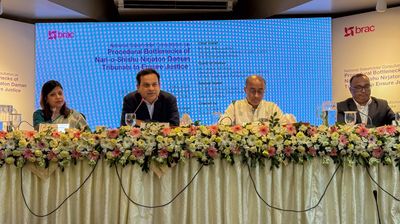
The findings were presented today, Saturday, 2 May, at a consultation meeting held at BRAC Centre in Mohakhali, Dhaka. The event was organised by BRAC’s Social Empowerment and Legal Protection (SELP) programme.
Speaking as the chief guest, Md. Asaduzzaman, Minister of Law, Justice and Parliamentary Affairs, stated that, among the three core parts of the state, the judiciary remains the most neglected institution. This is evident from national budget allocations. While the entire judiciary receives approximately BDT 22 billion, nearly BDT 25 billion is allocated to Bangladesh Television alone. He noted that managing judicial salaries, administrative costs, and infrastructure within such limited resources is highly challenging.
Referring to the government’s intention to reduce the number of pending cases from 4 million to 400,000, he added that cases often branch into multiple sub-cases, preventing meaningful reduction. He also observed that, in many instances, legal practitioners contribute to delays. He added that strengthening the effectiveness of the justice system requires improvements in mindset, structure and capacity.
The session was chaired by Asif Saleh, Executive Director of BRAC. He noted that people’s experiences shape public perceptions of the government in a few fundamental sectors, such as education, healthcare, law enforcement and the justice system. When services in these sectors are ineffective, overall public trust in the state declines.
He said that increasing the budget is necessary, but it is not a solution in itself. Without accountability, good governance, and a sense of responsibility at both individual and institutional levels, meaningful change will not occur. Ensuring a women and child-friendly justice system requires a results-driven approach. Achieving the desired justice system demands collective responsibility, with all stakeholders taking ownership. He also emphasised the need to strengthen a ‘whole-of-government’ approach, where the police, medical professionals, and representatives of the Ministry of Law work collaboratively to deliver justice, with a particular focus on those most vulnerable.
Asif Saleh further stated that if the majority of people in the country, particularly women, believe they will not receive justice when their rights are violated, they will lose confidence in the system. Restoring trust in the judiciary is a gradual process. For a humane state, it is essential to reduce the time required to obtain justice, establish victim-centred administration, ensure penalties for false cases, and, particularly, build a safe and effective justice system for women.
Special guest at the event, Md Monjurul Hossain, Director General, Directorate of Bangladesh Legal Aid, remarked that the low conviction rate often leads to the perception that cases are false, but the reality is different. Around 70% of women who experience violence do not pursue legal action due to social structures, stigma and ostracisation. Given the stringent penalties under the law, the accused often attempt to coerce and intimidate. Prolonged proceedings and procedural complexities weaken many cases over time.
In her welcome remarks, Shashwatee Biplob, Associate Director of BRAC’s Social Empowerment and Legal Protection (SELP) and Gender Justice and Diversity Programme, stated that although the Women and Children Repression Prevention Act 2000 was enacted to ensure swift justice, significant implementation challenges persist. Institutional reforms are critical to ensure timely and effective justice for claimants.
The session was moderated by ATM Morshed Alam, Legal Aid and Policy Advocacy Lead of SELP. The research overview was presented by Ummey Kulsum, Consultant and Former District and Sessions Judge.
The study analysed records and registers of 4,040 cases disposed of between January and June 2025 across 32 districts. It examined case duration, frequency of adjournments, repeated time petitions, types and outcomes of cases, profiles of witnesses and accused, average age and marital status of survivors, forensic and medical examinations, and patterns of conviction and acquittal.
The findings indicate that only 3% of cases resulted in conviction, while 70% ended in acquittal and 13% were settled. Although the law mandates disposal within 180 working days following investigation and trial, the average case duration was 1,370 days (3.7 years). On average, each case was scheduled for hearing 22 times.
Key barriers identified include the absence of complainants and witnesses, frequent adjournment requests, delays in investigation, weak evidentiary systems, and lack of witness protection.
Despite these persistent challenges, the Women and Children Repression Prevention (Amendment) Ordinance 2025 has reduced the statutory timeframe for case disposal to 90 days without adequately addressing the underlying procedural constraints.
The study offers several recommendations, including strict enforcement of statutory timelines, limiting unnecessary adjournments, ensuring accountability, timely availability of forensic and medical reports, strengthening the capacity of investigating officers, introducing performance evaluation mechanisms for prosecutors, ensuring in-camera and survivor-sensitive trials, expanding support services such as legal aid, counselling and shelters, and increasing the number of tribunals in districts with high caseloads.
Notably, SELP has received special recognition from the Government of Bangladesh for delivering legal aid services. In 2025, through 268 legal aid centres nationwide, the programme provided support to more than 25,000 individuals, approximately 90% of whom were women. It also reached nearly 1.1 million people with legal awareness messages, enhancing their confidence and ability to seek justice.