Ensuring effective classroom learning remains the most critical factor in improving the quality of primary education. Experts stressed the need for child-friendly curricula alongside more engaging and effective classroom teaching. They also emphasised strengthening teachers’ professional skills and capacities, as well as adopting research-based education strategies. According to them, frequent and unplanned curriculum changes remain a major challenge to ensuring quality education.
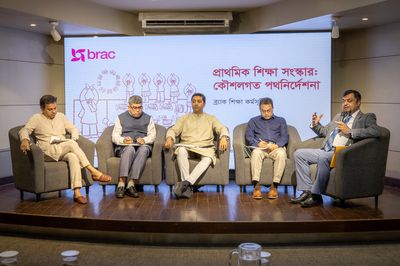
These observations were made at a policy dialogue titled ‘Primary Education Reform: Strategic Directions’, organised by BRAC’s Education Programme. The event was held on Monday, 13 April, at the BRAC Centre in Mohakhali, Dhaka. It was noted at the event that the current government plans to increase budget allocations to improve primary education quality. Speakers also highlighted the importance of coordinated efforts between public and private sector institutions to advance the education sector.
The State Minister for Primary and Mass Education, Bobby Hajjaj, attended the event as the chief guest. Special guests included Abu Noor Md. Shamsuzzaman, Director General of the Directorate of Primary Education, and Debabrata Chakraborty, Acting Director General of the Bureau of Non-Formal Education. Asif Saleh, Executive Director of BRAC, was also present at the event.
In his remarks, Bobby Hajjaj said that significant gaps remain in the primary education curriculum. He noted that many students in Grades 4 and 5 struggle with reading and writing in Bengali, and that teachers are not adequately trained. He added that initiatives would be introduced to incorporate storytelling as a teaching method at the primary level, while cautioning that approaches such as storytelling and play-based learning should be integrated only after adequate testing and evaluation.
Highlighting the government’s focus on co-curricular activities, Bobby Hajjaj said that six sports would be introduced for students in Grades 4 and 5, in coordination with the Ministry of Youth and Sports. Cultural activities such as dance, music, drama and debate are also being prioritised. Competitions in sports and cultural activities will be organised from school, regional and national levels. He further noted that Bengali and mathematics would be standardised at the primary level, ensuring uniform teaching across all types of educational institutions.
Asif Saleh, Executive Director of BRAC, said, “There is no alternative to collective action if we are to improve the quality of education. We must begin by prioritising classroom learning. This requires focusing not only on advanced technologies, but on getting the fundamentals right. Change does not always mean something new or sophisticated; frugal innovation is essential to achieving maximum impact with limited resources.” Referring to the para-teacher model and adolescent clubs, he noted that such initiatives have strong potential to foster visible and confident leadership at the grassroots level.
Complementing the State Minister’s ‘3Cs’ (Curriculum, Classroom, and Consistency), Asif Saleh outlined BRAC’s ‘3Is’ as a framework for collaboration between government and non-government actors: Innovation—frugal yet effective models; Inclusion—ensuring access to education in the most marginalised areas; and Implementation—strengthening quality and monitoring mechanisms.
Emphasising that “the true test of any plan lies in its implementation,” he welcomed the proposed increase in the education budget, while stressing the need to focus on execution capacity.
He concluded by proposing a strong and impartial baseline study, a recommendation that was supported by the State Minister. “If we are to see tangible progress over the next two years, we must first understand the current reality. Only then can we ensure that every investment in education translates into meaningful improvements in children’s learning outcomes,” he added.
The discussion session, moderated by K A M Morshed, Senior Director at BRAC, featured contributions from invited guests. Government officials and experts present at the event also shared their perspectives. Safi Rahman Khan, Director of BRAC’s Education Programme, presented various models and long-standing field-level experiences of the programme.
Dr Erum Mariam, Executive Director of the BRAC Institute of Educational Development (BIED), underscored the importance of ensuring effective classroom learning. The session began with welcome remarks from Md. Moazzem Hossain, Programme Head of BRAC’s Education Programme.