The rapid rise of battery-powered rickshaws in Bangladesh’s urban transport system has created employment opportunities, contributed to local economies and provided people with an affordable mode of transport. At the same time, it has increased concerns over road safety, unregulated electricity use and environmental risks. Managing the sector and formulating policies therefore require more than simply regulating vehicles; they must also take into account the realities of the drivers, owners, garage operators, mechanics and passengers who depend on it.
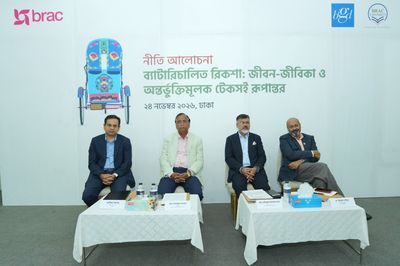
Speakers made these observations at a policy dialogue titled ‘Battery-run Rickshaws: Livelihoods and Inclusive Sustainable Transition’, held at the CIRDAP Auditorium in the capital on Tuesday, 24 November. The event featured findings from a study titled ‘Understanding the Political Ecology of Battery Rickshaws in Bangladesh’, conducted jointly by BRAC and the BRAC Institute of Governance and Development (BIGD). A policy brief developed based on the research findings was also presented, followed by discussions on the way forward.
Md Abdus Salam, Administrator of Dhaka South City Corporation, said that urban challenges such as traffic congestion, air pollution, waterlogging, mosquitoes and waste management are interconnected. Addressing one while overlooking the others would not lead to sustainable solutions. He said that just as city residents have the right to move around freely, rickshaw drivers also have the right to earn a living and work. However, ensuring adequate civic amenities would become increasingly difficult if everyone continued to migrate to Dhaka. He stressed the need for an integrated plan that considers the city's overall capacity, addresses these issues collectively and involves all relevant stakeholders.
Md Safiqul Islam Khan Milton, Administrator of Dhaka North City Corporation, said that the authorities were not against auto-rickshaws or their drivers, and that their right to earn a livelihood must also be protected. However, bringing the sector under a regulatory framework would establish accountability and enable the authorities to provide better support. While all the challenges may not be resolved overnight, initiatives have been taken to bring the currently unregulated sector within a formal legal framework, he added.
Asif Saleh, Executive Director of BRAC, said that the voices of people working in the informal sector rarely reach policymakers. The challenges surrounding battery-powered rickshaws, including safety, road management and regulation, must be addressed by considering drivers' realities and ensuring a just transition. He called on all relevant stakeholders to come together to develop a three-to-four-year transition plan that would enable gradual changes while minimising the impact on drivers and their families' livelihoods.
He added that informal sector workers, including rickshaw drivers and street hawkers, effectively pay an invisible tax every day. This money does not go to the state treasury but instead ends up in the hands of various vested interest groups. In the absence of legal recognition, these workers are repeatedly subjected to fines, extortion and various informal payments, without receiving any recognition or protection in return. The study found that 96 per cent of battery-run rickshaw drivers do not have a licence or permit, while two-thirds have experienced fines or harassment at some point. The burden of these irregularities falls on those living in poverty, while a privileged group benefits, he said.
He further noted that BIGD's research found that 78 per cent of battery-run rickshaw drivers in Dhaka had migrated from other districts, with 84 per cent citing a lack of employment opportunities in rural areas as the reason. People will continue to move to cities as long as rural areas lack adequate employment opportunities and farmers do not receive fair prices for their produce. Simply banning battery-run rickshaws will not change this reality; rather, abrupt decisions could push hundreds of thousands of families into even greater uncertainty.
Asif Saleh said that the country was going through a difficult economic period, with very limited opportunities for new employment. In this context, battery-powered rickshaws serve as a last resort for many families trying to make ends meet. Addressing the challenges therefore cannot be the responsibility of a single ministry. The ministries responsible for road transport, local government, power, environment, labour and agriculture must work together to ensure that the policies of one ministry do not contradict those of another. He emphasised the need for a whole-of-government approach that considers urban order, drivers' livelihoods and the rural economy together.
Dr Imran Matin, Executive Director of BIGD, said that rickshaw drivers depend on highly vulnerable livelihoods, where a single accident or instance of harassment could push them back into poverty. Pedestrians are citizens of this country, just as those who drive battery-powered rickshaws are. Any transition must therefore be designed to be fair and straightforward, keeping this reality in mind.
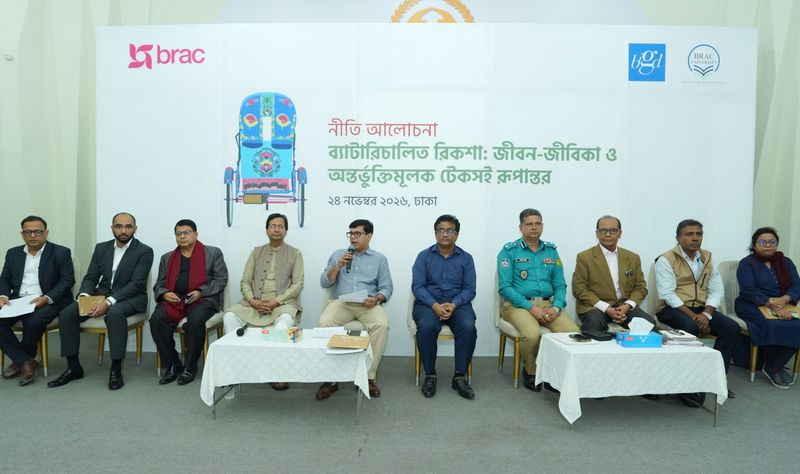
Nafiul Hasan, Director of Advocacy and Regulatory Affairs at BRAC, highlighted the policy considerations and realities on the ground and moderated a panel discussion during the second session of the event. The panellists included Md. Shamsul Hoque, former Director of the Accident Research Institute (ARI) at the Bangladesh University of Engineering and Technology (BUET); Sajjad Sharif, Executive Editor of Prothom Alo; Dr Akter Mahmud, Professor in the Department of Urban and Regional Planning at Jahangirnagar University; Ahmed Najmul Hussain, Director of Administration and Road Safety Programme at BRAC; Md Asfikuzzaman Akter, Joint Commissioner of Dhaka Metropolitan Police; Mohammad Shafioul Alam, Joint Secretary in the Local Government Division; Faraaz Rahim, Executive Director of Rahimafrooz Batteries Limited; Shahin Akhter, journalist at New Age; and Khalequzzaman Lipon, convener of the Rickshaw, Battery-run Rickshaw, Easy Bike Sangram Parishad.
The event began with welcome remarks from Shashwatee Biplob, Director of BRAC's Gender Justice and Diversity and Legal Protection and Social Empowerment programmes. Mehnaz Rabbani, operations director of BIGD, presented the research findings. Senior officials from the two city corporations, representatives of the Local Government Division, development practitioners, researchers, engineers, civil society representatives, organisations representing battery-powered rickshaw drivers and relevant experts also attended.
The study was conducted through a survey of 450 active battery-powered rickshaw drivers, including 300 in Dhaka and 150 in Barishal, alongside an assessment of the experiences of relevant stakeholders. Survey data were collected between 11 June and 30 July 2026.
Summary of research findings
The study found that 95.6 per cent of surveyed drivers did not have a licence or permit. Around 78.2 per cent rented the rickshaws they operated, spending an average of 38.6 per cent of their income on rental payments. If their earnings were to stop, 62.9 per cent would be unable to support their families for even a week. Furthermore, 26.7 per cent of drivers had experienced at least one road accident in the month preceding the survey.
The research also highlighted the important role played by garages in the battery-powered rickshaw ecosystem. Drivers depend on garages for vehicle rentals, charging, battery replacement, repairs, financial assistance and support in situations involving accidents or fines. However, the system is also associated with unregulated electricity consumption and the operation of garages on public land. Meanwhile, the informal production and recycling of conventional lead-acid batteries pose risks to the environment and public health.
The study noted that the ‘Three-wheeled Low-speed Battery-powered Rickshaw (E-rickshaw) Operation Rules’, formulated by the Local Government Division in 2026, represent an important step towards recognising the sector and bringing it under an organised regulatory framework. However, effective implementation will be the key challenge. Alongside road safety, environmental risks and regulatory mechanisms, the livelihoods of people associated with the sector must also be taken into account. An inclusive and sustainable transition should be introduced gradually, considering the financial capacities and practical realities of drivers, owners, garage operators and passengers.
Among the key recommendations of the study are developing a realistic, phased roadmap for formalising the sector, taking into account the implementation capacity of relevant government institutions and the ability of sector stakeholders to comply with the regulations. It also recommends immediately establishing minimum vehicle safety standards, designated operating zones and clear guidelines for road use. The costs associated with vehicle conversion or replacement, battery upgrades, charging, insurance and licensing should remain affordable for drivers and owners, so that they are not pushed out of their livelihoods and passenger fares do not increase significantly. Existing garages and service networks should also be integrated into the new system through appropriate support and incentives, rather than being excluded.
The study further emphasised the importance of promoting environmentally friendly charging systems and establishing effective mechanisms for collecting, safely disposing of and recycling used batteries.
It concluded that no single regulatory measure would be sufficient to manage the battery-powered rickshaw sector. Instead, responsibilities and coordination among relevant government institutions must be clearly defined, regulations must be enforced consistently and equitably, and stakeholders, including drivers, owners and garage operators, must be involved in both decision-making and implementation. This would help address road safety and environmental risks while safeguarding the livelihoods of people working in the sector and meeting the transport needs of passengers.