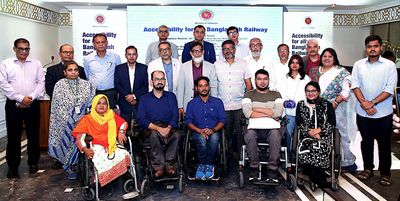
Ensuring accessibility for all at railway stations is essential to ensure safe, seamless and comfortable travel for passengers. Accessibility is not a special privilege or favour; ensuring accessibility is the responsibility of the railway authorities and an integral part of their service. People with disabilities and other passengers requiring assistance continue to face various challenges due to physical barriers at stations, difficulties in accessing essential information and digital services, as well as a lack of cooperation and awareness among relevant staff.
Participants made these observations at a workshop titled ‘Accessibility for All: Bangladesh Railway’. The workshop was organised by the Ministry of Railways, Bangladesh Railway and BRAC at a hotel in the capital on Tuesday, 18 August 2026. Alongside reviewing the physical infrastructure and facilities at railway stations, the workshop proposed policy reforms, staff training and the establishment of service standards.
Speaking as the chief guest, State Minister for Railways Habibur Rashid said that travel by railway would only be truly accessible when a person with a disability could move independently throughout their whole journey, including arriving at the station and purchasing a ticket to accessing the platform, boarding the train, reaching their seat, using the toilet and safely reaching their destination. He added, that people with disabilities should be involved at every stage of planning, design, implementation and evaluation.
As the special guest, Bangladesh Railway Secretary Md Fahimul Islam said, “Our primary goal is to make railway services safe, comfortable and accessible for everyone.” He further said that despite various infrastructure-related and other kinds of limitations, an integrated initiative had been undertaken under the new master plan to ensure seamless travel for the elderly and passengers with disabilities.
In his address as chair, Director General of Bangladesh Railway Md Afzal Hossain said Bangladesh Railway is currently placing greater emphasis on passenger-friendly services. Despite infrastructural and technological limitations, he expressed a commitment to developing a universally accessible system for all passengers, including people with disabilities.
Speaking as a special guest, Ahmed Najmul Hussain, Director of the Road Safety Programme at BRAC, said that BRAC works with marginalised communities, a significant proportion of whom are people with disabilities. He said BRAC would continue working to ensure accessibility for people with disabilities by reviewing the recommendations and views shared by stakeholders at the workshop.
Shashwatee Biplob, Associate Director of BRAC's Social Empowerment and Legal Protection and Gender Justice and Diversity Programme, said the country has numerous laws and policies, most of which are not implemented. “Even partial implementation of these laws and policies would help resolve many of the challenges we face,” she said.
Nafiul Hasan, Associate Director, Advocacy for Social Change Programme at BRAC, said that accessibility is not a privilege or favour, but a right. He said accessibility assessments had already been conducted at four railway stations across the country, identifying a number of areas requiring attention. He stressed the need for a coordinated initiative to ensure barrier-free and accessible railway services.
Mohammad Nazmul Islam, Bangladesh Railway Additional Director General (Operations), delivered the welcome remarks. He said, “We are working to build a railway system that is friendly and accessible to people with disabilities. Several initiatives have already been undertaken. The needs of people with disabilities are being taken into consideration in the construction of new railway stations and the procurement of new coaches.” He also said that the issue would receive due importance in the revision of the master plan.
Md Rupam Anwar, Additional Secretary to the Ministry of Railways, delivered the vote of thanks. Bangladesh Railway Chief Planning Officer Rafiqul Islam, Assistant Director at Centre for Disability in Development (CDD) Anika Rahman Lipy, and BRAC’s Consultant on Disability and Development Dr Nafeesur Rahman also presented findings and data from assessments on accessibility in railway services.
Representatives of people with disabilities and relevant organisations also participated in the workshop and shared their views. Participants emphasised that accessibility should not be treated as an additional facility, but established as one of the fundamental standards of railway services. They noted that people with different types of disabilities, including visual, hearing, physical and intellectual disabilities, have different needs. These diverse needs must therefore be taken into account when planning railway stations, platforms, coaches, ticket counters, information systems and other services. Participants called for accessibility to be incorporated from the outset in the design and construction of new infrastructure.
Government officials, relevant Bangladesh Railway officials, people with disabilities and organisations representing them, national and international development partners, development professionals, researchers, engineers, civil society representatives and relevant experts attended the workshop.