It has been over 75 years now since treatments for diabetes and hypertension were discovered – yet these diseases continue to be the world’s number one killer.
Deaths caused by non-communicable diseases (NCDs) now account for 75% of deaths globally. This includes almost 18 million premature deaths, 80% of which occur in low and middle-income countries.
Non-communicable diseases also have massive ripple effects – because of their effects on quality of life, but also because of the prohibitive costs associated with them. People with non-communicable diseases like hypertension and diabetes generally require medication for life, and are often hospitalised multiple times during their lifetimes. Bangladesh has the second highest out of pocket expenditure in the world, behind only Afghanistan, so these costs end up being borne mostly by individuals. This has clear broader societal impacts – each year health expenses drive 6.1 million people in Bangladesh into poverty. Anecdotal evidence from BRAC’s staff on the ground suggests this is particularly prevalent in urban slums, where households are now spending up to half of their income on medical bills.
A new collaboration that’s starting to turn the tide
In Bangladesh, a new initiative by the Government of Bangladesh, BRAC and Medtronic Labs, a global leader in healthcare technology, is showing promising results in turning this tide. The initiative – titled NCD360° – has managed to almost triple the control rates of hypertension, bringing them up from 31% to 72%, and almost double the control rates of diabetes, bringing them up from 23% to 47%.
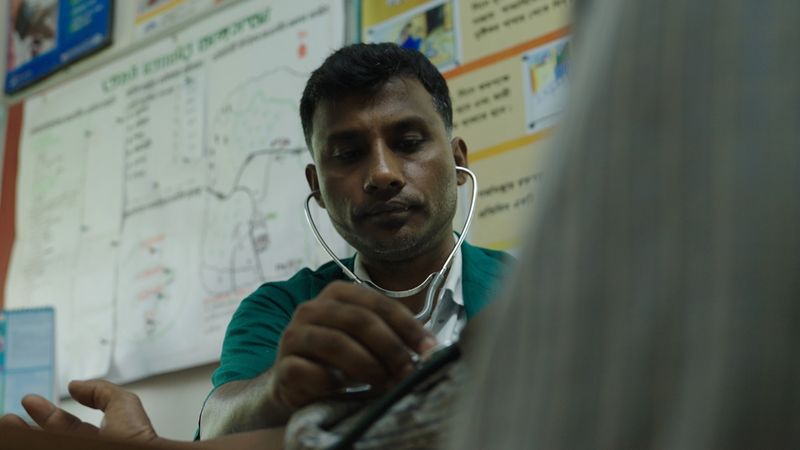
A community health care provider checking the blood pressure of their patient in a community clinic in northern Bangladesh. © BRAC
NCD360° builds on a decade of efforts by the Government of Bangladesh. By the turn of the 21st century, the non-communicable disease epidemic in Bangladesh was becoming too big to go unnoticed. In 2012, the government redeveloped the public healthcare policy and started opening dedicated non-communicable disease corners in upazila health complexes – frontline public hospitals in each subdistrict. The corners were designed to have a dedicated doctor and nurse who would assess and consult patients and provide free medicine. Bangladesh now has more than 400 such corners across the country.
The corners made some impact, but large-scale progress was hindered by a combination of factors – a lack of doctors and nurses willing to work in them, insufficient budget for the quantity of medicine needed, but – most critically – a lack of public awareness about non-communicable diseases.
While these diseases are critical, they are also slow-onset, so create a false sense of security.
In 2023, the government partnered with BRAC and Medtronic Labs to figure out how to raise health-seeking behaviour. The resulting initiative – NCD360° – draws on BRAC’s extensive network of community health workers, and a customised technology solution from Medtronic Labs. NCD360° was implemented in the two districts of Bangladesh with the highest rates of non-communicable diseases – Nilphamari, in northwestern Bangladesh, and Narayanganj in central Bangladesh.
Asif Saleh, Executive Director, BRAC, visits Nilphamari, in July 2025. © BRAC
Taking awareness – and technology – to doorsteps
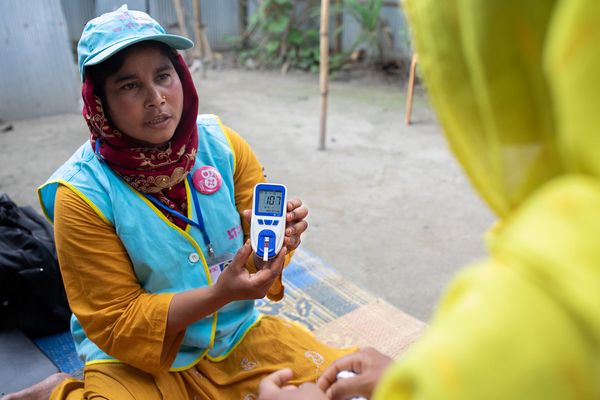
NCD360° saw hundreds of BRAC community health workers add awareness raising, screening and follow-ups for non-communicable diseases to their regular door-to-door visits. During each visit, they use a mobile app to submit blood sugar and blood pressure levels. The app tells them whether there is a concern, and the person should be referred to a frontline government primary health outpost, or community health clinic – or whether the patient has a critical condition and needs to be referred directly to an NCD corner.
If the person is referred to a community clinic, a government health care provider does a basic assessment and refers them to the nearby NCD corner. If the person is referred to an NCD corner, a nurse assesses the person’s condition, and a doctor then diagnoses the person’s condition and prescribes treatment, and then a health educator from BRAC sits with the person to explain the treatment and counsel on necessary lifestyle modification requirements, self-care – and answers any questions they may have. Community health workers, supported by staff in a dedicated call centre, then follow up regularly until the patient’s disease is under control.
NCD360° has screened 143,527 people to date, which amounts to approximately one-third of the most at-risk population segments in the two districts. Health-seeking behaviour has noticeably risen – almost a quarter of the people that were referred to and received healthcare in NCD corners during this period were referred by community health workers. The initiative has also sparked a broader ripple effect. General awareness about non-communicable diseases is growing, and increased traffic into NCD corners is fostering a heightened sense of accountability among doctors and nurses in them, which is also supporting the flow of medicines to the corners. The initiative has been likened to adding an electrical connection between the community and the existing government health infrastructures, sparking a current that is enlivening the whole system.
The initiative is now being scaled to five more districts in northern Bangladesh where the burden of non-communicable diseases is particularly high. A lot is still to be figured out, though. As an example, only 1 in 3 people referred for diagnosis actually enrolled in the system and went on to receive care. Similarly, a large number of people, like Ashamoni’s father and uncle, get diagnosed but then do not follow the treatment.

The whole system is tied together with a mobile app which connects community health workers, community clinics and NCD corners with the central control room in the capital. © BRAC
The potential goes beyond non-communicable diseases — and beyond Bangladesh
Just as non-communicable diseases have ripple effects on other conditions in a person’s body, a lack of investment in non-communicable diseases has ripple effects across societies.
Non-communicable diseases will be the leading cause of disability across the world by 2030. In Bangladesh, non-communicable diseases are already the cause of 63% of disabilities. Investments in holistic public health solutions offer up to seven-fold returns, by reducing premature deaths, illness and disability.
Health shocks are also a clear cause of poverty, and there are broader societal concerns as well, such as children like Ashamoni being at higher risk of child marriage as a result of her father’s death.
With deaths linked to non-communicable diseases projected to increase by 17% in the next decade, and health budgets shrinking globally, we need to be thinking differently about how we can tackle this wave. One way is by combining the strengths of community-based non-governmental organisations, advancements in technology, and leveraging public investments.