Daorui Mro, a 6-year-old girl from the indigenous Mro community, lives atop a hill called Minnikpara with her family in Bandarban in remote southeast Bangladesh. She started fetching water with her mother last year. Now, it’s the sole responsibility of the six-year old. She walks for an hour downhill every morning and returns at noon with water.
This is not just Daorui’s story – it is the reality of countless children in Bangladesh.
For millions in Bangladesh, access to clean water remains a daily battle. In remote communities, especially in the Chittagong Hill Tracts, this struggle is deeply ingrained in everyday life. In Bangladesh, 3.3 million people still lack access to clean water close to home. Without piped water, the burden of fetching it falls disproportionately on women and girls – they are more than ten times as likely than men to be responsible for fetching water. When families have clean water close to home, girls can stay in school, women can pursue livelihoods, and entire communities can thrive.
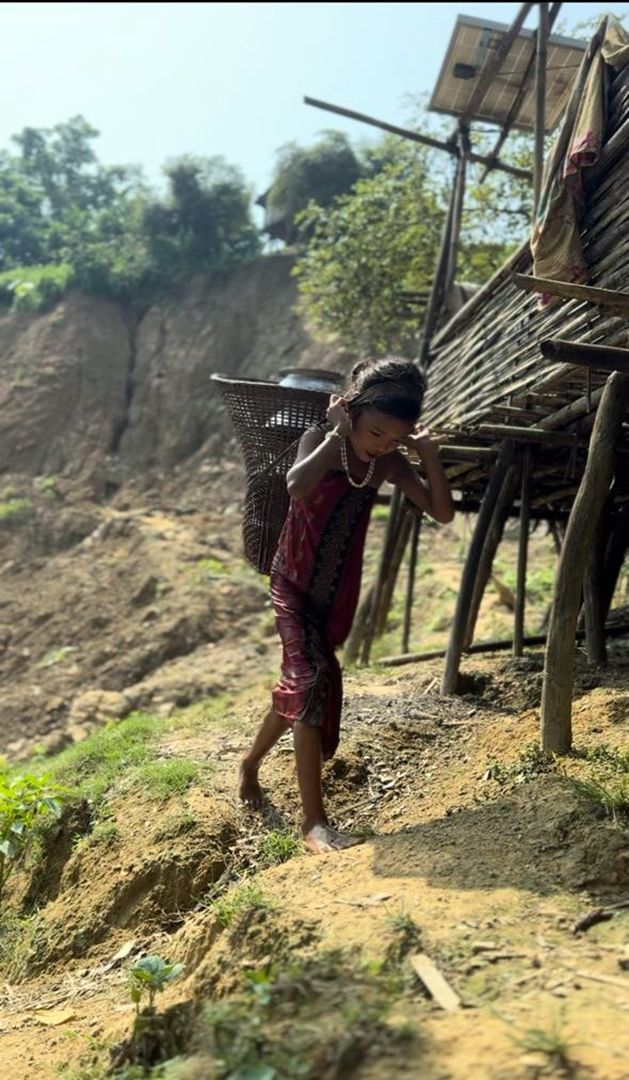
Daorui returns home at noon, carrying four cooking pot of water she went to fetch at dawn © BRAC
In hard-to-reach areas like Bandarban, a hilly district in southeastern Bangladesh, the journey to find water stretches for hours. Even after reaching a stream, the indigenous communities living there have to search for water. The water they finally get is not safe for drinking. Finding water is more difficult in summers as these small streams of water dry up.
Beyond survival: The cost of water insecurity
A study has shown that 85% of water collection is done by women and 4.7% by girls. In Chittagong Hill Tracts area, this extra task of collecting water leaves women to shoulder the increasing burden of household and farm responsibilities.
The water crisis is not limited to one crisis but is connected with other problems. The time spent fetching water keeps girls out of school, limits their opportunities, and puts their health at risk. It is a sacrifice no child should have to make.
The consequences of using unsafe water or open sources are dire: waterborne diseases such as diarrhoea and skin infections, particularly among children and the elderly, are rampant. This has not only burdened their daily lives but has also perpetuated cycles of poverty, poor health, and limited opportunities, particularly for women and children.
The longest wait in Jogendra Para
For the people of Jogendra Para in Bandarban, waiting for water is an exhausting routine. Tutuli Tanchangya, a community member from this area, describes the struggle. They have a water pit from a nearby water stream, but the demand far exceeds the supply.
“I wake up with the sun and go outside to collect water. This is my first task in the morning as the queue for water is very long. The most frustrating part is the wait.”
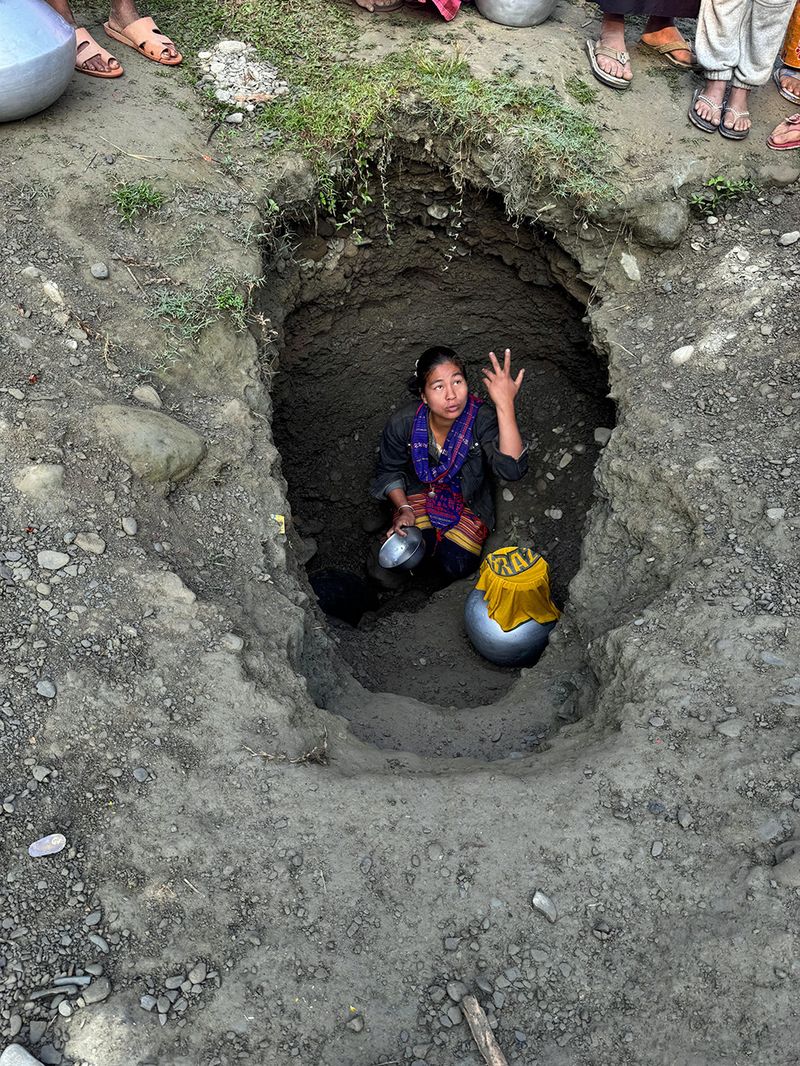
Tutuli at Jogendra para waiting for hours until water flows into the pit, a daily struggle to survive © BRAC
To fill each pot, she must sit in a pit-like hole and wait for the water to trickle in. Each pot requires 40 to 50 minutes to fill. Sometimes, Tutuli can only fill one pot before she has to leave for her job as a day laborer on other people’s land.
“One pot of water is not enough; I often have to collect water again in the evening after returning home. In winter, the water pits become dry. I am forced to collect water from the river during that season which is even more unsafe. Livestock and other animals also use the same river. My four-year-old son continues to suffer from diarrhoea; in our community, children have skin diseases as well,” said Tutuli.
Piping hope: Problem identification
Kyaw May Ching, a community member from the Marma community and leader of the Village Development Organisation (VDO), faced a similar situation to Tutuli Tanchongga even a few months ago in 2024. She joined the VDO platform after hearing that other women from her community join together to discuss their problems and make decisions to solve them for their community.
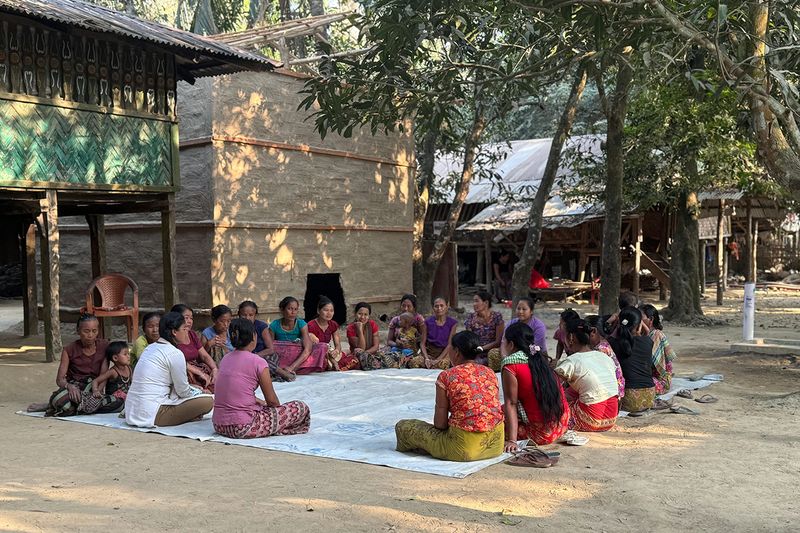
Women from the indigenous community gather for a VDO meeting, identifying and discussing the challenges they face. © BRAC
“Ali bhai (from BRAC) asked us in our meeting about the number one problem in our Marma community of Mong Pa Khai Para village. We identified water as our first problem. Later on, through multiple meetings with our community leader, other members, and community women, we made the decision to establish a piped water network.”
Community as a local agent of change
Community members of Mong Pa Khai Para are responsible for making the system sustainable and taking ownership. This piped water system has been a collaborative effort, with the community playing an integral role. People from the community contributed approximately BDT 113,333 BDT (15.2% of the project cost) and volunteered during various stages of construction, including transporting materials and installing the water tanks.
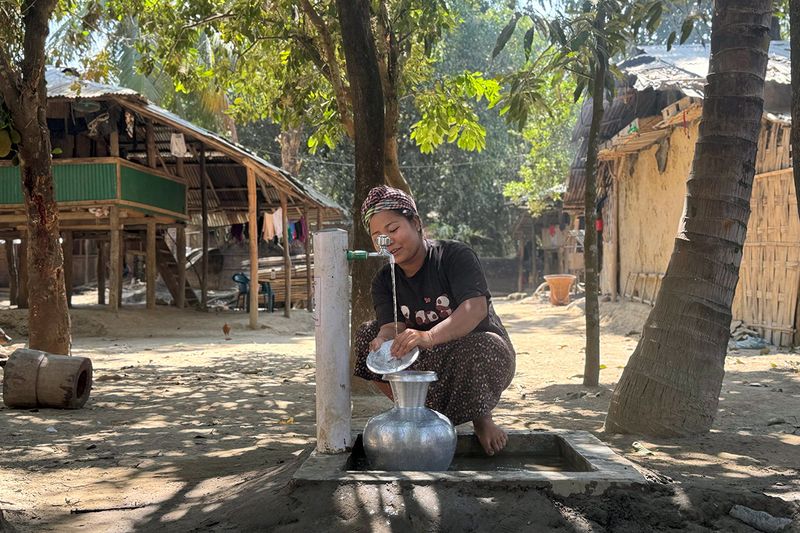
Now the community members like Kay mi ching, 141 households have access to safely managed water in Mong Pa Khai Para. © BRAC
It has a deep borehole with a capacity of 10,000 liters stored in two tanks, now situated atop a three-story school building. This system is set to transform the lives of the community by providing safely managed water directly to the village via an underground pipe network through twelve water points.
“We have formed a committee of seven members to decide how to pay the electricity bills and maintain the system,” shared Kaymi Ching Marma.
The piped water network, developed through community participation and financial contribution with technical support from BRAC Integrated Development programme, now provides safely managed water to 141 Marma households in remote Kurukpata Union in Alikadam of Bandarban.
Crisis demand action
Chittagong Hill Tracts is a home to almost 1.85 million people, nearly half of whom belong to 11 indigenous communities. For these indigenous populations, access to water is not just a development challenge, it is a daily uphill battle, intertwined with marginalisation, geography, and generations of exclusion. The water crisis in communities like Jogendra Para and Mong Pa Khai Para is not an isolated issue; it is deeply connected to broader challenges like health, education, livelihoods, and gender equity.
The success of the piped water initiative in Mong Pa Khai Para offers more than just relief—it provides a blueprint for sustainable, community-led development across the Global South. In regions where geography, inequality, and systemic neglect intersect, top-down solutions often fail to reach those most in need. But when communities have the tools to identify their own challenges and lead the response, solutions become not only more relevant but also more resilient.