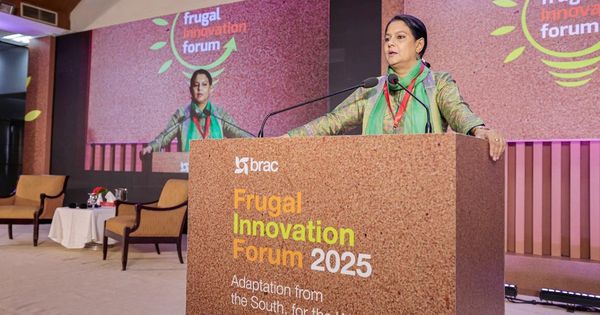
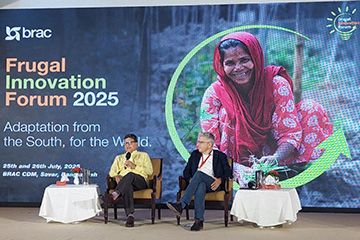
Syeda Rizwana Hasan, Honourable Advisor to the Interim Government on Environment, Forest and Climate Change, stressed that nature-based adaptation must go beyond symbolic or superficial efforts. In her view, this approach entails the protecting of rivers, canals, forests, and farmland, rather than mertely offsetting emissions while continuing with unsustainable business practices. She emphasised that mitigation efforts must progress in parallel with adaptation strategies; without this balance, adaptation alone will be insufficient.
She further drew attention to the injustice experienced by vulnerable countries like Bangladesh, which suffer the consequences of emissions from developed nations yet are often offered support in the form of loans. This, she noted, amounts to a double injustice. Rizwana Hasan also pointed out that lower national emissions can no longer be used to justify carbon-intensive development. Every development initiative—from power plants to infrastructure—must be aligned with climate-sensitive planning.
Underscoring the importance of grassroots involvement, she called for stronger collaboration with local actors. She urged the government to acknowledge and partner with organisations such as BRAC, which are making a tangible impact on the ground. She argued that effective climate adaptation cannot be achieved through top-down measures alone. Bangladesh’s communities continue to demonstrate remarkable resilience, and it is imperative that this resilience be matched with supportive policies and institutional backing.
She made these remarks on the closing day of the 8th Frugal Innovation Forum (FIF) 2025, organised by BRAC. Also speaking at the closing session of the second day of the forum were Dr Hossain Zillur Rahman, Chairperson of BRAC and Jerome Oberreit, Executive Director of BRAC Global.
On the opening day of the forum, held on Friday, the welcome address was delivered by BRAC’s Executive Director Asif Saleh, while the keynote was presented virtually by His Excellency Mohamed Nasheed, Secretary General of the Climate Vulnerable Forum and former President of the Maldives.
Dr Hossain Zillur Rahman remarked that innovation in the context of climate change is no longer a luxury—it is a necessity. He added that we are innovating on the run, responding to real-life challenges that demand immediate and practical solutions. Local knowledge must not be seen as separate from scientific knowledge; it must be unpacked, understood, and integrated, as it holds critical insight into viable, context-specific solutions. He further mentioned that the search for frugal innovation is not just a technical mission—it is also a moral one: moral in our effort to protect the planet, and moral in our responsibility to safeguard the lives and livelihoods of affected populations.
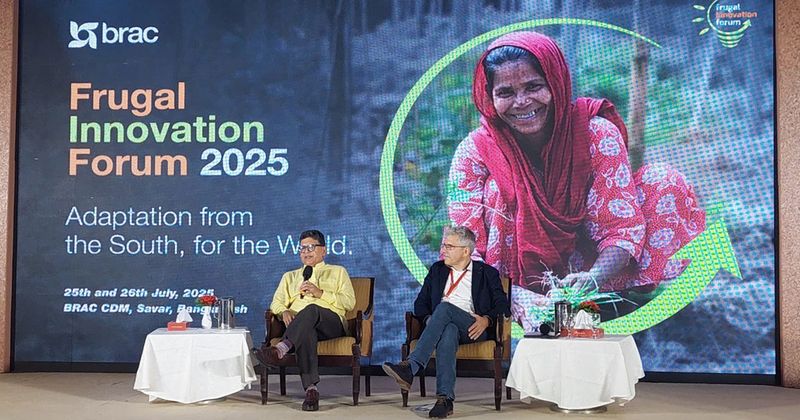
Jerome Oberreit said that frugal innovation is not about flashy technology—it arises out of necessity and is driven by the ingenuity of those navigating the harshest realities, such as farmers who struggle more each year just to survive. He added that access to knowledge must now be treated with the same urgency as access to food, water, or healthcare—because without it, we risk continuing to leave behind those most vulnerable to the impacts of climate change.
In a panel discussion, Dr Abed Chaudhury, a renowned non-resident Bangladeshi scientist and the Co-Founder and Chief Scientist of Genofax Life Sciences, remarked that we live in a dysbiotic world—one where pollution knows no borders. He added that BRAC’s efforts represent transformational change. He emphasised that the work of both Genofax and BRAC falls within the realm of transformational innovation and expressed his eagerness to continue this journey in collaboration with BRAC.
With the theme ‘Climate Adaptation in Agriculture, Food Security and Livelihoods’, the two-day forum took place on 25 and 26 July (Friday and Saturday) at BRAC Centre for Development Management (BCDM), Savar. More than 200 experts, entrepreneurs, researchers and development professionals from both national and international spheres participated in the event.
The second day of the forum began with welcome remarks from KAM Morshed, Senior Director at BRAC, who also shared a recap of Day One.
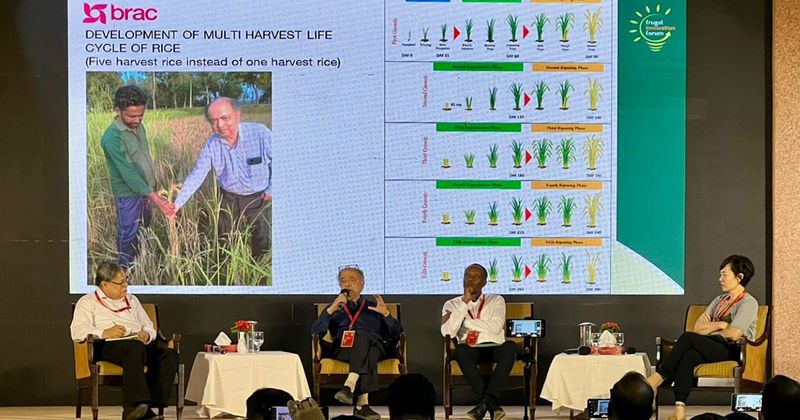
The day featured a series of thematic sessions including: ‘Creating an Enabling Environment: Uniting the Private and Public Sector’, moderated by Moutushi Kabir, Senior Director of People, Culture and Communications at BRAC; 'Frugal Innovation for Climate-Resilient Agriculture, Food Security, and Livelihood' moderated by Christina Chan; ‘Community in the Driving Seat’, moderated by Hossain Ishrath Adib, Director of BRAC’s Water, Sanitation and Hygiene, Integrated Development, and Ultra-Poor Graduation programmes; ‘What Needs to be in the Solution Basket for Farmers to Adapt’ and ‘Innovation in Agricultural Inputs’, moderated by Ashley Toombs, Head of the Climate Hub at BRAC International; and ‘Financial Products and Climate Risk Insurance’, moderated by BRAC’s Senior Manager Kuldeep Bandhu Aryal.
Throughout the two-day forum, participants explored how locally grounded and cost-effective climate adaptation strategies—rooted in community knowledge and experience—can be scaled for broader impact. Topics such as regenerative agriculture, nature-based solutions, climate information services, financial inclusion, and market linkage strategies were also explored in depth by experts, researchers, and innovators, with a focus on practical implementation.
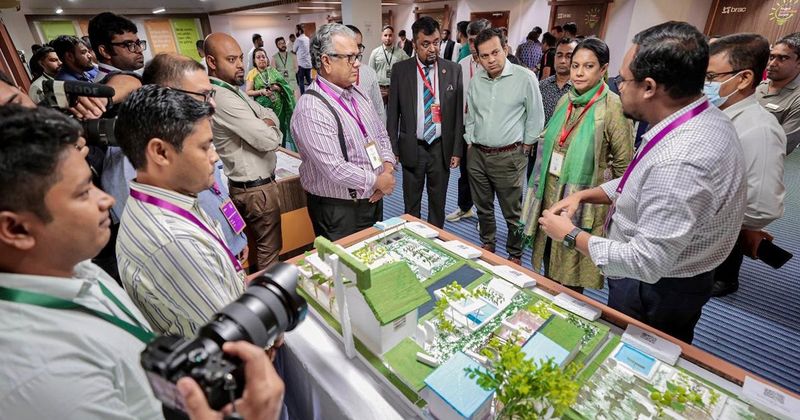
The innovation exhibition also featured climate-resilient, agriculture-based solutions by organisations such as SAJIDA Foundation, WeGro, and World Vision. The showcase highlighted how these technologies and innovations are supporting smallholder farmers to cope with erratic weather patterns, declining yields, and post-harvest losses. Other sessions also discussed practical and context-specific strategies for climate risk insurance, climate-resilient seeds, digital advisory services, and agricultural finance.
Since its inception in 2013, the Frugal Innovation Forum (FIF) has served as a vital platform for the Global South to explore innovations and feasible solutions. Previous editions have addressed themes ranging from digital financial inclusion to post-COVID recovery.
As the climate crisis worsens and adaptation financing shrinks, this year’s Frugal Innovation Forum sends a clear message: climate resilient futures must be built from the ground up—along with communities, not just for them.