Primary healthcare must take centre stage in health sector reforms, with health insurance introduced to ensure coverage for all. Strengthening secondary and emergency healthcare is equally vital, alongside granting hospitals financial autonomy to manage resources, including manpower, salaries, and allowances. Reducing out-of-pocket expenses for citizens remains a key priority. For holistic progress, NGOs, private entities, and social service organisations must be officially recognised and work in coordination with the government to bring about meaningful change. Most importantly, Universal Health Coverage (UHC) must be given due consideration.
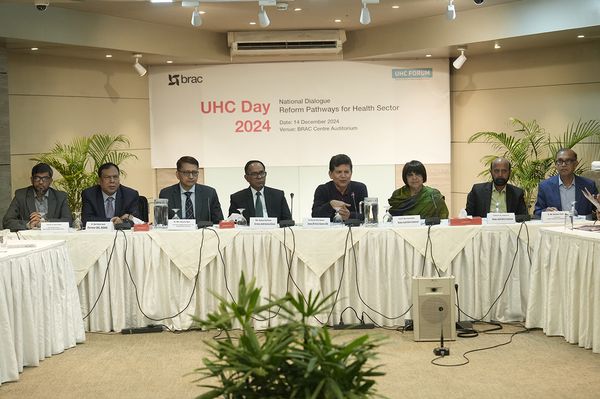
These were the key takeaways from the national dialogue titled “Reform Pathways for Health Sector” held at the BRAC Centre Auditorium in Dhaka on Saturday, 14 December 2024, to mark UHC Day 2024. The UHC Forum, a coalition of multi-skilled professionals dedicated to advancing Universal Health Coverage, hosted the event in collaboration with BRAC.
The dialogue convened policymakers, health professionals, civil society members, development partners, and representatives from media to assess the current state of Bangladesh’s health sector and identify actionable reform agendas.
Md. Saidur Rahman, Secretary of the Health Services Division, and Dr. Md. Sarwar Bari, Secretary of the Medical Education and Family Welfare Division of the Ministry of Health and Family Welfare (MoH&FW), attended as esteemed guests. Dr. Hossain Zillur Rahman, Convener of the UHC Forum and Chairperson of BRAC, delivered the welcome address and summarised the discussions during the closing session.
Panel discussions featured insights from Dr. Syed A. Hamid, Professor at the Institute of Health Economics, University of Dhaka; Dr. Abul Kalam Azad, former Director General of the Directorate General of Health Services (DGHS); Professor Dr. Liaquat Ali, Member of the Health Reform Commission; Dr. Naila Z. Khan, Member of the Health Reform Commission; and Dr. Md. Akramul Islam, Senior Director of BRAC’s Health Programme and Humanitarian Crisis Management Programme.
Md. Saidur Rahman, Secretary of the Health Services Division, emphasised, "We must recognise the valuable contributions of NGOs and the private sector and support their efforts so we can all work cohesively under a unified framework. Rather than assigning blame, let us focus on collaborative action. By working together, we can confidently achieve our shared goals."
Dr. Md. Sarwar Bari, Secretary of the Medical Education and Family Welfare Division, stated, "The health sector has the potential to drive progress in poverty reduction, employment, and climate resilience. As we navigate this transformative period, it is crucial to envision bold reforms or ‘think big’. However, meaningful change within the ministry often requires an external ‘push’. This ‘push’ can come from civil society, sector experts, NGOs, and other relevant stakeholders."
Dr. Hossain Zillur Rahman, Convener of the UHC Forum and Chairperson of BRAC, remarked, "We need to approach healthcare with a focus on multiple angles and priority areas. These include access to care and service delivery, community engagement, and the promotion of preventive health. We must prioritise quality services that are patient-centred while also addressing health finance, human resources, and the overall capacity of the health sector. These are significant challenges that need to be tackled holistically. Equally important is defining the pathway for reforms and overcoming the implementation challenges that lie ahead."
Dr. Syed A. Hamid, Professor at the Institute of Health Economics, University of Dhaka, highlighted, "If we are to ensure social health insurance for all, the government must address the challenge of premium collection without subsidies. Additionally, reforming public financial management laws and improving allocative efficiency are essential to optimise resources and eliminate duplication, especially at the local levels. A unified framework can therefore bundle healthcare services and assign appropriate value.”
Dr. Abul Kalam Azad, former Director General of the Directorate General of Health Services (DGHS), commented, "Healthcare in Bangladesh suffers from inequitable access and inadequate service delivery, leaving providers and patients dissatisfied. To address this, UHC must be prioritised. With out-of-pocket expenditures at 70 per cent — far above the 20 per cent standard set by WHO — comprehensive reforms are needed in primary, referral, intermediary, and emergency care services. Only through these reforms can we achieve an equitable and accessible healthcare system."
Professor Dr. Liaquat Ali, Member of the Health Reform Commission, said, "The public expects a clear pathway for health sector reforms from the interim government, with a focus on equity for gender and marginalised communities. Reforming and streamlining the structure and delivery of primary healthcare is essential. The government must also empower citizens to take responsibility for their health. Allocating more budget to primary healthcare, rather than secondary and tertiary care, is crucial to ensuring equitable access for all."
Dr. Naila Z. Khan, Member of the Health Reform Commission, stated, "We need to adopt a citizen-centred approach, instead of disease-oriented health system, focusing on people’s strengths and building on them, rather than just addressing weaknesses. Happiness and well-being are essential factors. Healthcare terminology should reflect a more humane and approachable outlook, considering both accessibility and mental health. Our healthcare system must be universal and easily acceptable to all.”
Dr. Md. Akramul Islam, Senior Director of BRAC’s Health Programme and Humanitarian Crisis Management Programme, commented, "Social participation is crucial for a robust healthcare system, yet it remains largely absent in Bangladesh. Meaningful engagement must happen at every level — from service delivery and policymaking to monitoring and accountability. Currently, public involvement is often symbolic rather than substantive. For the health system to truly thrive, we must empower communities to actively participate at all stages and levels of decision-making."
The dialogue, held on Martyred Intellectuals Day, highlighted the urgency of addressing systemic challenges in the health sector through measurable accountability, strengthened foundational systems, and the inclusion of health as a constitutional right. Participants emphasised that meaningful reforms require more than the establishment of a reform commission — they advocated for a fundamental shift in actionable priorities with a renewed sense of urgency.