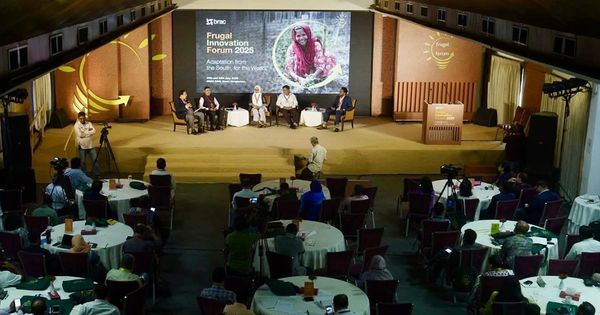
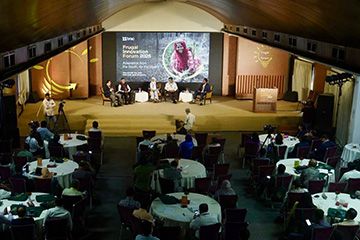
More than 200 national and international experts, entrepreneurs, researchers and development practitioners convened for the eighth Frugal Innovation Forum (FIF), held on 25 and 26 July (Friday and Saturday) at BRAC’s Centre for Development Management (BCDM) in Savar. This year’s forum centred on the theme of ‘Climate Adaptation in Agriculture, Food Security, and Livelihoods’, focusing on practical, locally-rooted solutions for navigating climate risks across the Global South. Discussions were anchored in community-led innovations and context-specific realities.
The event opened with a one-minute silence in remembrance of the Milestone School and College tragedy. The opening address was delivered by BRAC Executive Director Asif Saleh, while His Excellency Mohamed Nasheed, Secretary General of the Climate Vulnerable Forum and former President of the Maldives, joined virtually to deliver the keynote speech.
In his keynote, H. E. Mohamed Nasheed stated that the current structure of the international financial system neither serves the interests of vulnerable countries nor supports effective climate action. Developing nations, he argued, are being priced out of essential investments in clean energy and resilient infrastructure due to prohibitively high borrowing costs. While the need for adaptation is vast, access to finance remains severely constrained. For any meaningful progress, he stressed that affordable finance must be treated as an urgent global priority.
Asif Saleh noted that while "the world is on fire", it is also, in many ways, at a breaking point. He emphasised that disaster-related economic losses, now amounting to $2.3 trillion annually, are falling hardest on those in the Global South who are least equipped to bear them. He underscored the need for conversations on climate adaptation to go beyond survival — and speak equally to livelihoods, dignity, and inclusive growth.
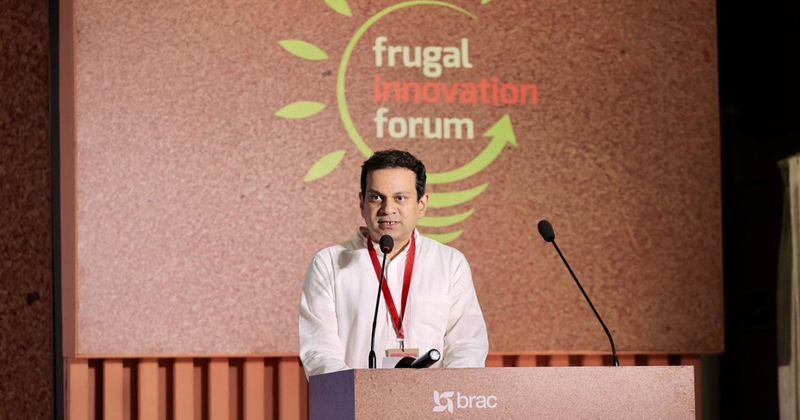
Citing data, Asif Saleh stated that nearly USD 700 million people still live on less than USD 2.15 a day — almost 99% of them in the Global South. Kabul is projected to become the first modern city to completely run out of water, with its aquifers potentially drying up within five years. On our current trajectory of 2.7°C of global warming, nearly 2 billion people will be exposed to deadly, extreme heat — again, almost all of them in the Global South.
The climate crisis, he warned, is no longer a future threat. Over the next 25 years, longer heatwaves, erratic rainfall, and intensified floods and droughts are expected to cause cascading disruptions across food systems — not only in Bangladesh, but throughout the Global South. He elaborated on the relevance of this year’s theme, centred on climate, adaptive agriculture, and livelihoods. Over the course of the event, participants explored best practices, examined emerging research and technologies, and built cross-sector and cross-border partnerships essential for driving change at scale. "In the long run", he reflected, "we already know what becomes possible when innovation is rooted in trust, in community, and in dignity."
Throughout the two-day event, panel discussions, impact talks, and exhibitions explored feasible adaptation strategies reflecting the lived experiences of climate-vulnerable populations. The forum emphasised how communities can lead resilience-building efforts by drawing on local knowledge and limited resources.
On the first day, sessions addressed topics such as transformational adaptation in agriculture; navigating uncertainty through climate information services; practical innovations for smallholder farmers; and use cases tailored for practitioners, governments, and industry actors.
Moderators included Christina Chan, Senior Director of BRAC’s Climate Hub; Ashley Toombs, Head of the Climate Hub at BRAC International; Degefu Getachew, Senior Manager of the Climate Programme at BRAC International Kenya; Kuldeep Bandhu Aryal, Senior Manager at BRAC; and Professor Anwarul Abedin of Bangladesh Agricultural University (BAU).
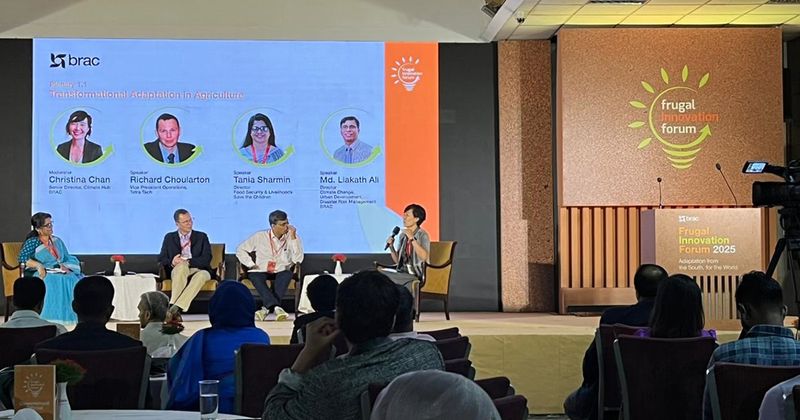
Discussions highlighted how frugal climate adaptation methods — developed through local ingenuity and experience — can be scaled to broader systems. Participants explored actionable approaches in regenerative agriculture, nature-based solutions, climate information systems, financial inclusion, and market access models.
Innovations by BRAC’s Frugal Innovation Fellows were also featured, including: Esther Kimani from Kenya, Ghislain Irakoze from Rwanda, and Mubasshir Tahmid from Bangladesh. Their initiatives exemplified how grassroots innovation can enhance climate resilience through community-driven solutions and resource-efficient approaches.
In addition, climate-resilient agricultural technologies developed by organisations such as SAJIDA Foundation, WeGro, World Vision, Poverty Alleviation Cluster, BRAC’s Climate Change Programme (CCP) and Social Innovation Lab (SIL), Frugal Innovation Fellows, InsureCow, iFarmer and Green Delta Insurance were showcased. These innovations demonstrated how local solutions and technologies are helping smallholder farmers tackle unpredictable weather, minimise crop loss, and recover from post-harvest challenges.
Other sessions delved into locally appropriate models for climate risk insurance; resilient seed systems; digital advisory services; and financing options for climate-resilient agriculture.
The closing session, to be held tomorrow (Saturday, 26 July) at the same venue, will feature remarks from Syeda Rizwana Hasan, Honourable Adviser to the Interim Government on Environment, Forest and Climate Change. BRAC Chairperson Dr Hossain Zillur Rahman will deliver the concluding address.
Since its inception in 2013, the Frugal Innovation Forum (FIF) has served as a key platform for exploring innovation and sustainability from the perspective of the Global South. Previous editions have tackled topics ranging from digital financial inclusion to post-COVID recovery.
As the climate crisis intensifies and global adaptation finance dwindles, this year’s FIF delivers a clear message: climate-resilient futures must be built from the ground up — with communities, not just for them.