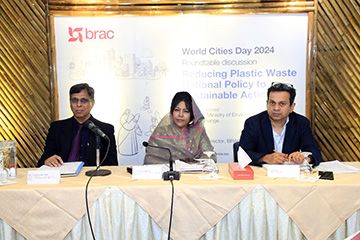
Experts emphasised that while enforcing laws is critical, fostering public awareness and investing and promoting alternatives to reduce plastic use is equally essential. Effective implementation of plastic bag bans will drive demand for viable alternatives, encouraging the private sector to innovate and invest on substitutes. Although legislation to ban plastic bags was enacted in 2002, meaningful enforcement has remained elusive for the past 22 years. The government has now taken steps to address this issue, but plastic dependency has become deeply ingrained as an addiction within society.
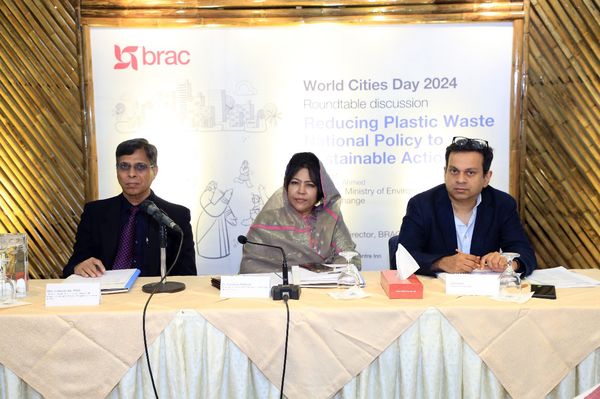
These insights were shared by speakers at a roundtable discussion titled “Reducing Plastic Waste -- National Policy to Sustainable Actions”. Organised by BRAC in observance of World Cities Day, the event took place on Monday, 4 November 2024, at the BRAC Centre in Mohakhali.
Dr Farhina Ahmed, Secretary of the Ministry of Environment, Forest, and Climate Change, was the Chief Guest at the event, which was chaired by BRAC’s Executive Director, Asif Saleh.
Chief Guest Dr. Farhina Ahmed stated, "The plastic we discard today will persist for over 400 years without decomposing. Plastic bags were banned 22 years ago, and the notion that there is still no alternative is unacceptable. While the government will provide full support, we cannot expect ready-made solutions handed to us. We are all custodians of our natural resources, and we urge everyone involved to work with us to enforce the plastic bag ban effectively this time." She said her ministry is doing everything possible, but it will require a whole-of-government approach with the active participation of the Ministry of Local Government, Rural Development and Cooperatives (LGRD) ministry.
BRAC's Executive Director, Asif Saleh noted, “Plastic products remain widely used due to their low cost. Many people still choose plastic because it is inexpensive, and there is limited awareness of its environmental and health impact. There is a general reluctance to pay extra for eco-friendly alternatives.” He added, "Simply providing alternatives to plastic is not enough. These alternatives must be as affordable as plastic, if not cheaper. Tax policies need to incentivise investment in green business so that they can be nurtured and grown as demand for them increase over time, driven by greater awareness and policy enforcement by the government."
In his keynote presentation, Director of BRAC's Urban Development, Climate Change, and Disaster Risk Management Programmes, Md. Liakath Ali, PhD, stated, "Based on the National Action Plan for Sustainable Plastic Management, our targets are to achieve a 50 per cent recycling rate by 2025 and reduce plastic waste generation by 30 per cent by 2030. Our experience has shown that issues with law enforcement, consumer behaviour, and the recycling ecosystem are the root causes of plastic waste in Bangladesh. Strong collaboration among public and private sectors, civil society, and communities is vital to addressing the crisis."
Senior Director of BRAC Enterprises, Mohammad Anisur Rahman remarked, "Hard plastic is almost entirely recycled due to its market value. In contrast, flexible or single-use plastics have no commercial value for recycling, which is why they are commonly found littered everywhere. In countries like Taiwan, the government provides subsidies to curb the use of such single-use plastic items."
Company Secretary and Head of Legal and Taxation of Nestlé Bangladesh Limited, Debabrata Roy Chowdhury commented, “As the largest food company in the world with the highest compliance in Bangladesh, we plan to achieve 100 per cent reusable and recyclable packaging By 2030. However, there are several challenges to address in reaching this goal. A major challenge is that only 30 per cent of total plastic waste is generated by the formal sector, while the rest comes entirely from the informal sector.”
Ecologist and Social Justice Advocate with the Environmental and Social Development Organisation (ESDO), Shahriar Hossain, PhD, said, "Bangladesh was the first country in the world to ban plastic, yet we have not fully enacted it. For 22 years, we failed to enforce the law and find alternatives, leading to an addiction to plastic. Changing this mindset and embracing alternatives is within our reach. I believe that with strict enforcement, we can develop sustainable solutions ourselves."
Other distinguished speakers included Dr. Engineer Tariq Bin Yousuf, Waste Management and Sanitation Expert; Professor Dr. Tanvir Ahmed, Director, International Training Network Centre (ITN) of Bangladesh University of Engineering and Technology (BUET). Additional perspectives were shared by Kabir Hussain, Conservancy Inspector; Shamim Akhter, Social Development Officer of Cox’s Bazar Municipality; Tamim Hossain, Head of IT and Media, BD Clean; and Arlin Karim, Co-facilitator, Amra Notun Network (Khulna) during an open discussion session.
The roundtable opened with an address by Imamul Azam Shahi, Programme Head of BRAC’s Urban Development Programme (UDP). The open discussion session was moderated by Sankalita Shome, Chief Coordinator of the Bangladesh Sustainability Alliance (BSA).
The event also featured exhibitions by BRAC and three manufacturers of plastic alternatives -- Engreen, Pisces, and ProPad -- showcasing innovations in biodegradable plastic substitutes and upcycled materials. These exhibitions highlighted the creativity and commitment people are bringing to plastic waste management solutions.
Bangladesh generates 800,000 tonnes of plastic waste annually (World Bank 2021), of which 87,000 tonnes is single-use plastic (ESDO 2021). In Cox's Bazar alone, 34.5 tonnes of plastic waste is improperly dumped each day. By 2050 oceans will have more plastics than fish (The Washigton Post 2016). Already plastic has been found in breastmilk (The Guardian), sea foods (FAO 2017), and even clouds (Science Daily 2023).